
How to Search Floyd County Court Records
Floyd County court records do not live in one public database. Superior Court civil and criminal files are handled through the Floyd County Clerk of Superior Court and the related Floyd County court portal. Magistrate Court has a separate public-records search path for small civil cases, dispossessories, garnishments, county ordinance matters, warrants, first appearances, bond hearings, and preliminary hearings. Probate Court uses Georgia Probate Records for estates, marriage licenses, guardianships, wills, traffic dockets, and hearing calendars.
Start with the record type, not the person's name alone. A felony indictment, divorce, or land-title dispute belongs with the Clerk of Superior Court. A small claim or county warrant application belongs with Magistrate Court. A will, estate, guardianship, or outside-city traffic citation belongs with Probate Court. A city traffic or ordinance case from Rome usually belongs with Rome Municipal Court's payment and search portal. If none of those channels shows the record, Floyd County's NextRequest portal is the countywide fallback for public records that are not controlled by a court-specific custodian.
- Identify the court from the citation, filing, notice, warrant, or case paperwork before searching.
- Use the Superior Court case-search link for Superior civil, felony criminal, divorce, equity, and land-title matters.
- Use the Magistrate Court public-records search for small civil claims, dispossessories, county ordinances, bad-check matters, warrants, and preliminary criminal events.
- Use Georgia Probate Records for probate, marriage, guardianship, will, traffic docket, death-information, and miscellaneous probate filings.
- Request copies from the responsible clerk when the online index is incomplete, blocked, older, sealed, or not enough for legal use.
Floyd County Court Records Search Fields
Field-level access varies because several Floyd County court records systems are provider portals. The Superior Court case-search endpoint was not visible during research because the official access point blocked automated inspection, so exact field labels should be confirmed inside the live portal before relying on a search method. The Probate portal did expose useful module tiles, and Rome Municipal Court exposed driver-license and Social Security number search paths for payable city matters. Those portal details help show why a broad Floyd County court records search often requires more than one stop.
| Channel | Search Inputs | Required | Notes / Format |
|---|---|---|---|
| Superior Court case search | Case search through Floydcourts.com | Varies | Official portal exists, but direct field inspection was blocked. Confirm current name, case number, and date filters in the live portal. |
| Georgia Probate Records | Portal tiles by record type | No | Tiles include estate information, recorded marriage licenses, traffic dockets, wills, guardianship petitions, death information, calendars, weapons carry, and fee calculator. |
| Rome Municipal Court | Driver's license, state, date of birth, or Social Security number and date of birth | Yes for selected method | Public HTML showed driver-license and SSN methods enabled; date format is MM/DD/YYYY. |
| Cott land records | Index and land-record search | Account for documents | Guest access shows index data only. Viewing and printing documents requires subscription access and per-page print costs. |
The Cott land records search is shown in the Floyd County court-record image set from its official source.
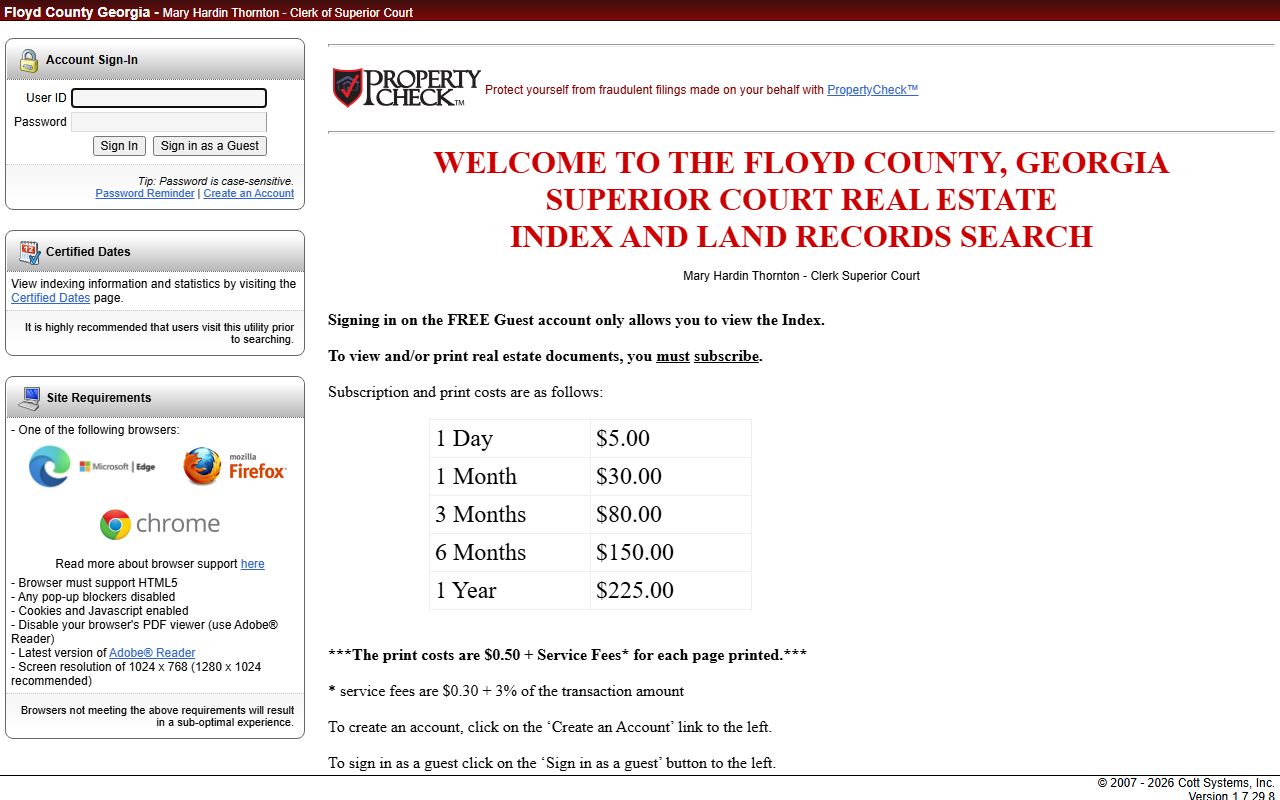
That image belongs with real estate and lien research because land-record document viewing is a different access channel from ordinary case searches.
Types of Floyd County Court Records
Floyd County court records reflect Georgia's court structure. Superior Court is the general-jurisdiction court for felony criminal cases, divorce, equity, title-to-land disputes, habeas corpus, mandamus, declaratory judgments, and major civil matters. Magistrate Court creates records for small civil claims, dispossessories, garnishments, FiFas, abandoned vehicle and mobile-home cases, personal-property foreclosures, warrants, first appearances, bond hearings, preliminary hearings, bad-check matters, and county ordinance cases. Probate Court creates records for estates, guardianships, conservatorships, marriage licenses, weapons carry licenses, wills for safekeeping, and traffic citations issued outside city limits.
Some Floyd County court records are not ordinary case files. The Clerk of Superior Court also keeps real estate records, liens, executions, lis pendens, hospital liens, tax liens, UCC filings, plats, trade names, jury records, and notary appointments. Rome Municipal Court keeps city traffic and ordinance records for matters inside Rome. Juvenile Court handles delinquency, dependency, CHINS, juvenile traffic, emancipation, and transfer matters, but juvenile access is more limited than adult court access.
- Superior Court records include felony cases, divorce files, major civil matters, title-to-land disputes, orders, verdicts, sentences, and appeals from lower courts.
- Magistrate Court records include small claims, evictions, garnishments, first appearances, bond hearings, search warrants, arrest warrants, and ordinance cases.
- Probate Court records include estates, marriage licenses, guardianships, conservatorships, wills, death information, and outside-city traffic dockets.
- Municipal and traffic records include Rome city citations, city ordinance cases, and payment or appearance status.
- Real estate and lien records include deeds, plats, UCC filings, tax liens, executions, lis pendens, and trade-name filings.
What Floyd County Court Records Show
Floyd County court records usually show the case number, court, division, party names, filing date, events, judge or courtroom, and current status when those fields are public. The exact display depends on the court. A Superior Court criminal file may show charges, arraignment, motions, plea, verdict, disposition, bond orders, sentencing, probation revocation entries, and appeal events. A civil case may show complaint, answer, service return, motions, continuances, orders, judgment, garnishment, or FiFa events. A probate file may identify a decedent, petitioner, ward, guardian, executor, filed date, granted date, and hearing calendar entries.
| Field | What It Shows |
|---|---|
| Case number | The identifier assigned by the court, such as Superior, Magistrate, Probate, Municipal, warrant, or traffic formats. |
| Parties | Plaintiff and defendant, State and defendant, petitioner and respondent, decedent, ward, guardian, or other named participants. |
| Case type | Civil, criminal, divorce, probate, traffic, warrant, garnishment, dispossessory, lien, or other filing category. |
| Docket events | The running list of filings, service, hearings, motions, orders, continuances, pleas, judgments, warrants, and appeals. |
| Financial fields | Filing fees, service fees, publication costs, fines, court costs, restitution, bond amounts, copy fees, or recording costs. |
| Restriction markers | Redactions, sealed status, juvenile limits, protected identifiers, or a note that complete documents require clerk confirmation. |
- Docket
- The chronological list of filings, hearings, orders, and other events in a court case.
- Disposition
- The current or final outcome of a case or charge, such as dismissed, guilty, judgment entered, or closed.
- Certified copy
- A clerk-issued copy carrying certification for official use, rather than a screen print or ordinary downloaded copy.
Public Access to Floyd County Court Records
Georgia public access starts with openness, but the record custodian and the record type matter. The Georgia Open Records Act, O.C.G.A. 50-18-70 et seq., presumes public records are open unless a law or court order makes them exempt. O.C.G.A. 50-18-71 covers inspection, copying, retrieval, redaction, and allowed charges. For Floyd County, the public-records fallback is NextRequest, where the county names the County Clerk as records custodian for Georgia Open Records Act purposes.
Court files should still start with the court office that keeps the case. Certified Superior Court copies come from the Clerk of Superior Court, not from a general county records portal. Probate-certified copies should start with Probate Court. Magistrate files should start with Magistrate Court. Clerk employees cannot give legal advice under the legal-advice limits cited by the Clerk's real estate page, so they can help locate or copy records but cannot choose forms, interpret a judgment, or tell a filer what legal step to take.
Note: Online access may show index and docket facts, while certified copies and older files require direct clerk confirmation.
The Georgia Probate Records portal is one of the successful court-record images assigned to this page.
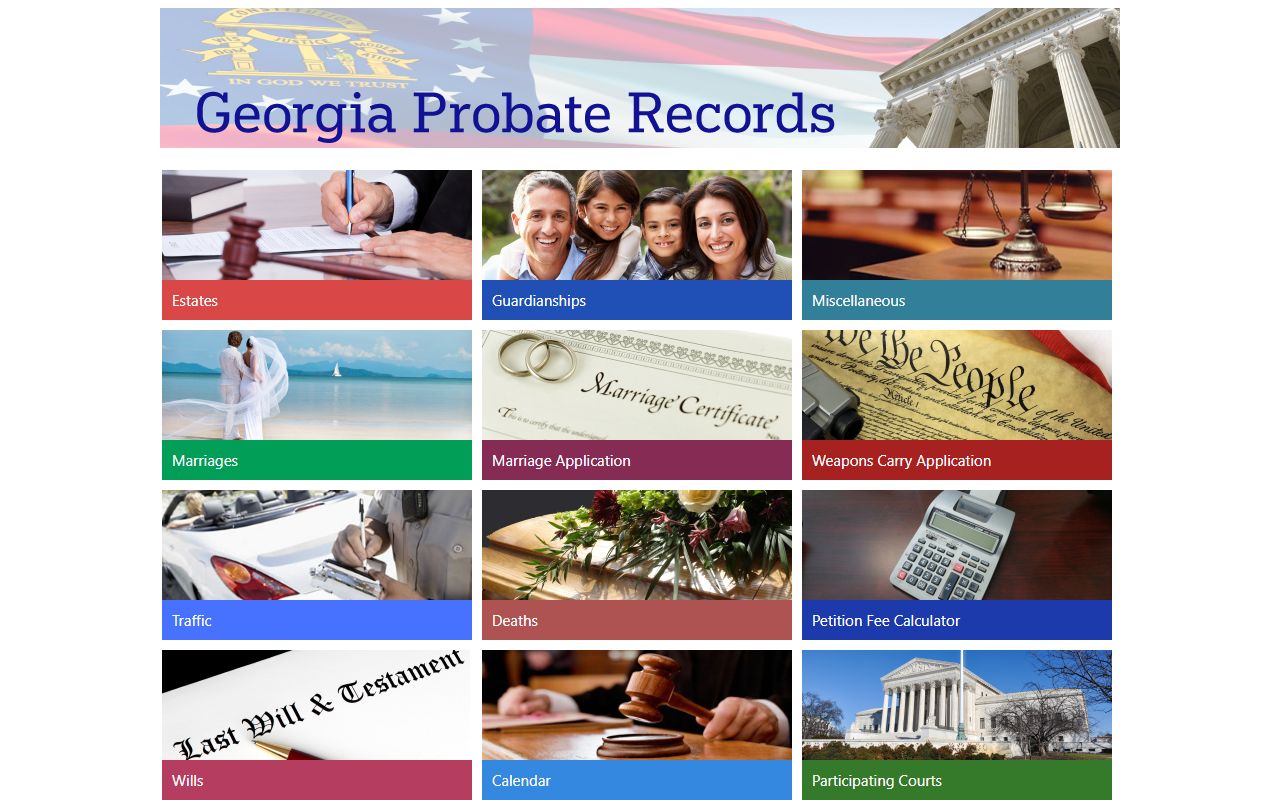
Probate access is important in Floyd County because that court handles more than estates, including marriage, guardianship, wills, and some traffic dockets.
Restricted Floyd County Court Records
Not every Floyd County court record is public in full. Juvenile Court records are treated differently from adult criminal and civil files. Floyd Juvenile Court covers delinquency, dependency, CHINS, juvenile traffic, emancipation, competency, and some transfers, and the research confirms special juvenile traffic handling where youth must appear with a parent. Adoption files, mental-health proceedings, guardianship medical facts, protected addresses, Social Security numbers, financial-account numbers, minor names, and sealed material may be withheld or redacted.
Georgia also uses record restriction for certain criminal-history records under O.C.G.A. 35-3-37. That process is not the same as making every court record vanish. For arrests after July 1, 2013, the GBI says eligible restriction usually runs through the prosecutor. For older arrests, the person generally applies through the arresting agency. Court-file sealing is separate, and a docket may still show public information unless a judge restricts access under the required legal process.
Floyd County Court Record Requests
In-person and mail requests are still important because online searches can be incomplete, blocked, or limited to indexes. Clerk of Superior Court Mary Hardin Thornton is the primary officer for Superior Court civil, criminal, divorce, land, lien, trade-name, notary, and certified-copy requests. The office is in the Floyd County Courthouse / Judicial Center at 3 Government Plaza, Suite 101, Rome, Georgia 30161. The Clerk site lists 706-291-5190, while the GSCCCA Floyd County clerk profile lists (706) 314-1860 and Monday through Friday office hours of 8:00 AM to 5:00 PM except holidays.
Sheriff Dave Roberson's office is a separate source for sheriff-created records such as jail, warrant, and incident-related material. Those records should start with the Floyd County Sheriff's Office, while court filings and certified case copies should start with the court custodian.
Copy fees depend on the record and service. The Clerk fee schedule lists unassisted uncertified copies at $0.50 per page, assisted uncertified copies at $1 per page, certified or exemplified copies at $2.50 for the first page, and appeal record preparation at $1 per page. Real estate documents may be brought to the deed room or mailed to the Clerk of Superior Court, Attention: Deed Room Suite 103, 3 Government Plaza, Rome, GA 30161. The real estate page also states that faxed documents are not accepted for recording because Georgia requires original signatures.
Clerk of Superior Court
3 Government Plaza, Suite 101
Rome, GA 30161
706-291-5190
Monday-Friday, 8:00 AM-5:00 PM except holidays